What does a clay paver drive involve?
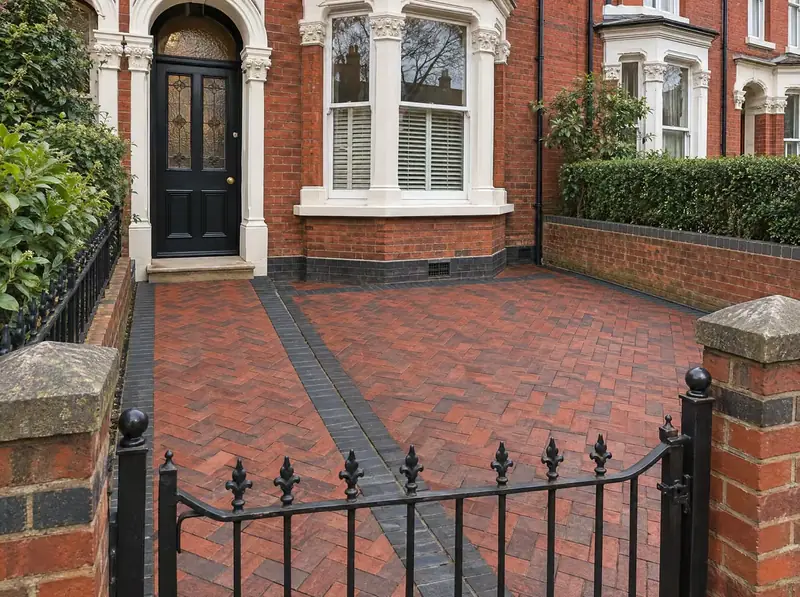
Clay block paving uses pavers made from fired clay rather than concrete. The colour runs right through the paver and does not fade, so a clay drive looks much the same after twenty years as it did when it was laid, and it weathers in the way a brick wall does.
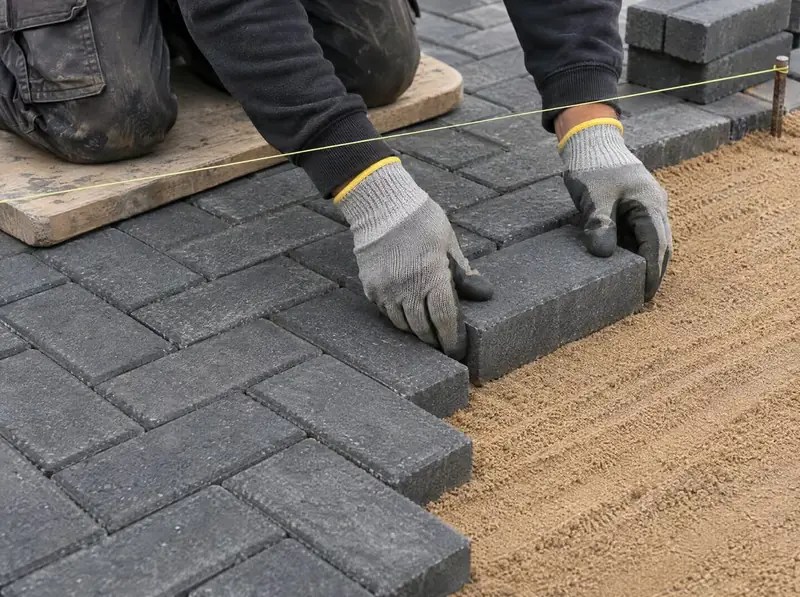
Clay pavers are laid on the same kind of compacted sub-base and sand bed as concrete blocks, but they vary slightly more in size and are harder to cut cleanly, so laying takes longer and the cost per square metre is higher. They are a natural match for Victorian, Edwardian and Arts and Crafts houses.
What is included?
- Advice on paver colour and size to suit the house
- Dig-out, edging and compacted sub-base
- Clay pavers laid in herringbone, basketweave or stretcher bond
- Clean cuts with a wet saw where the pattern meets edges and covers
- Jointing sand brushed in and the surface compacted with a protective pad
Which options are there?
Standard clay pavers
Crisp, square-edged pavers in reds, browns and brindles.
Tumbled or rumbled clay
Pavers with softened, aged edges for a reclaimed look.
Clay with a contrasting border
Blue-black or dark brindle clay as a soldier course around a red field.
How much does a clay paver drive cost?
For a 40 m² drive in the Midlands, that typically comes to £4,600–£6,800. London and the South East cost more, the North East, Yorkshire and Wales a little less. Smaller jobs cost more per square metre because set-up and waste costs do not shrink with the area.
| Region | Guide price inc VAT |
|---|---|
| London | £140–£205 per m² |
| South East | £125–£185 per m² |
| East of England | £120–£180 per m² |
| South West | £115–£170 per m² |
| West Midlands | £115–£170 per m² |
| East Midlands | £115–£170 per m² |
| North West | £115–£170 per m² |
| Yorkshire and the Humber | £105–£155 per m² |
| North East | £105–£155 per m² |
| Wales | £105–£160 per m² |
| Scotland | £115–£170 per m² |
| Northern Ireland | £110–£160 per m² |
Guide figures checked 9 November 2026. Your written quote after the survey is the price you pay. See the full price list or try the guide price tool.
Is a clay paver drive right for you?
Good for
- Period properties and conservation areas
- Colour that will not fade
- Paths and frontages where detail shows
Think twice if
- The lowest budget
- Very large, plain drives where a concrete block does the same job for less
How does it work?
Tell us about the job
Use the form, the quote tool, WhatsApp or a call.
We take a look
A survey visit, or photos for smaller repair and cleaning jobs.
Price in writing
Every line itemised, including the dig, edging and drainage.
Booked and built
Agreed start date, then the work, the final clean-down and the joint top-up.
Do you need permission?
Front-garden paving and dropped kerbs follow different rules in each part of the UK:
Front drive rules in England
In England, paving in front of the house that covers more than 5 m² needs planning permission unless it is permeable or drains to a lawn, border or soakaway inside your boundary. Permeable block paving, or standard blocks laid to fall onto a planted strip, avoid the need for permission in most cases.
Flats and maisonettes, listed buildings, and homes covered by an Article 4 direction can have tighter rules, and conservation areas, National Parks and National Landscapes restrict some permitted development.
A dropped kerb needs your local highway authority's approval (usually the county, unitary, metropolitan or London borough council), and a new access onto an A, B or C classified road also needs planning permission.
Front drive rules in Wales
In Wales, any new or replacement hard surface at the front of a house should be permeable or drain to a permeable area within the property to avoid needing planning permission. Unlike England, there is no 5 m² allowance for new paving; only repairs of up to 5 m² of existing surface are exempt.
Since January 2019, construction work covering 100 m² or more with drainage implications, including drives and patios, needs approval from the local SuDS Approving Body (SAB) before work starts, even where planning permission is not needed.
A dropped kerb needs your council's approval as highway authority, and a new access onto a classified road needs planning permission.
Front drive rules in Scotland
In Scotland, a hard surface between the house and the road is permitted development only if it is porous or drains to a permeable area within the property. There is no 5 m² threshold: the rule applies whatever the size.
Hard surfaces are not permitted development in a conservation area or within the grounds of a listed building, so planning permission is needed there.
A dropped kerb needs consent from your council as roads authority under section 56 of the Roads (Scotland) Act 1984, and planning permission may also be needed depending on the road.
Front drive rules in Northern Ireland
In Northern Ireland, a hard surface between the front of the house and the road that covers or replaces more than 5 m² must be porous or permeable, or drain to a permeable area within the property, to be permitted development.
Hard surfaces within the grounds of a listed building need listed building consent. Planning is handled by your district council, so check with its planning office if you are unsure.
Dropped kerbs in Northern Ireland are approved by DfI Roads (the Department for Infrastructure), not the council; check planning separately with the council.
Questions about clay pavers
Is clay block paving better than concrete?
Neither is better for every job. Clay holds its colour for decades and suits older houses; concrete costs less, comes in more shapes and is easier to match later. Both last well on a good sub-base.
Do clay pavers fade?
No. The colour comes from the clay and the firing, so it does not wash out in sunlight the way some pigmented concrete blocks gradually do.
Are clay pavers slippery?
Clay pavers for paving are made to a slip standard for external use. Moss and algae make any surface slippery, so a yearly clean matters more than the material.
Can clay pavers take car traffic?
Yes, when laid in herringbone on a proper sub-base. Most clay pavers for drives are 50 mm or 65 mm thick.
Where do you offer clay paver drives?
We quote clay paver drives across the UK. Choose your area for local prices and towns.
- Bedfordshire
- Berkshire
- Bristol
- Buckinghamshire
- Cambridgeshire
- Cheshire
- Cornwall
- Cumbria
- Derbyshire
- Devon
- Dorset
- County Durham
- East Riding of Yorkshire
- East Sussex
- Essex
- Gloucestershire
- Greater London
- Greater Manchester
- Hampshire
- Herefordshire
- Hertfordshire
- Isle of Wight
- Kent
- Lancashire
- Leicestershire
- Lincolnshire
- Merseyside
- Norfolk
- North Yorkshire
- Northamptonshire
- Northumberland
- Nottinghamshire
- Oxfordshire
- Rutland
- Shropshire
- Somerset
- South Yorkshire
- Staffordshire
- Suffolk
- Surrey
- Tyne and Wear
- Warwickshire
- West Midlands
- West Sussex
- West Yorkshire
- Wiltshire
- Worcestershire
- Clwyd
- Dyfed
- Gwent
- Gwynedd
- Mid Glamorgan
- Powys
- South Glamorgan
- West Glamorgan
- Aberdeen and Aberdeenshire
- Dundee and Angus
- Argyll and Bute
- Ayrshire
- Dumfries and Galloway
- Edinburgh and the Lothians
- Fife
- Forth Valley
- Glasgow and Dunbartonshire
- Highlands
- Lanarkshire
- Moray
- Perth and Kinross
- Renfrewshire and Inverclyde
- Scottish Borders
- County Antrim
- County Armagh
- County Down
- County Fermanagh
- County Londonderry
- County Tyrone
Related services
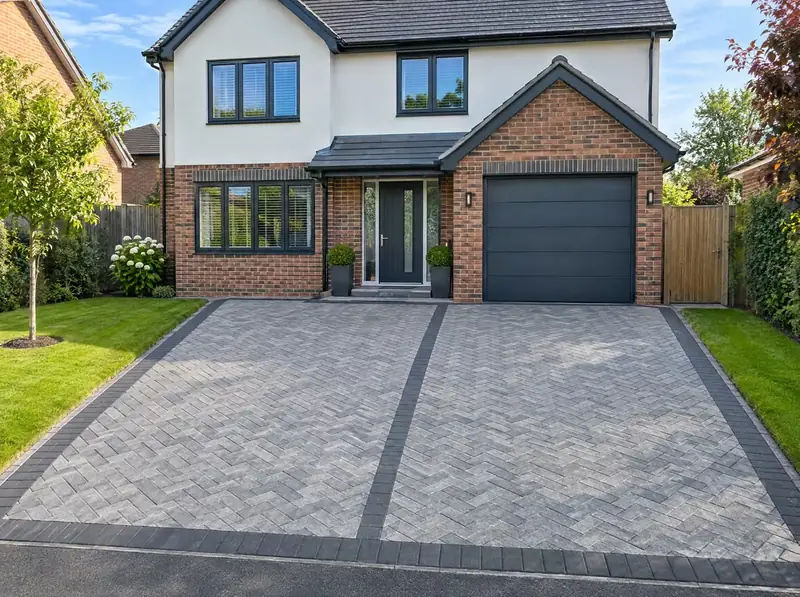
Block paving driveways
A new block drive built from the sub-base up, in the pattern and colour you choose.
From £85 per m²Learn more →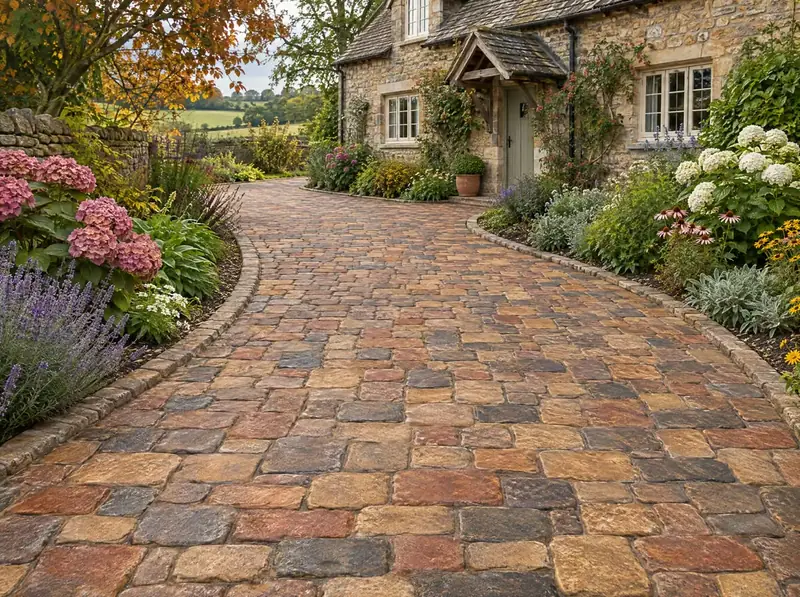
Tumbled and cobble-effect block paving
Mixed-size, softened-edge blocks for a traditional, cottage-style finish.
From £100 per m²Learn more →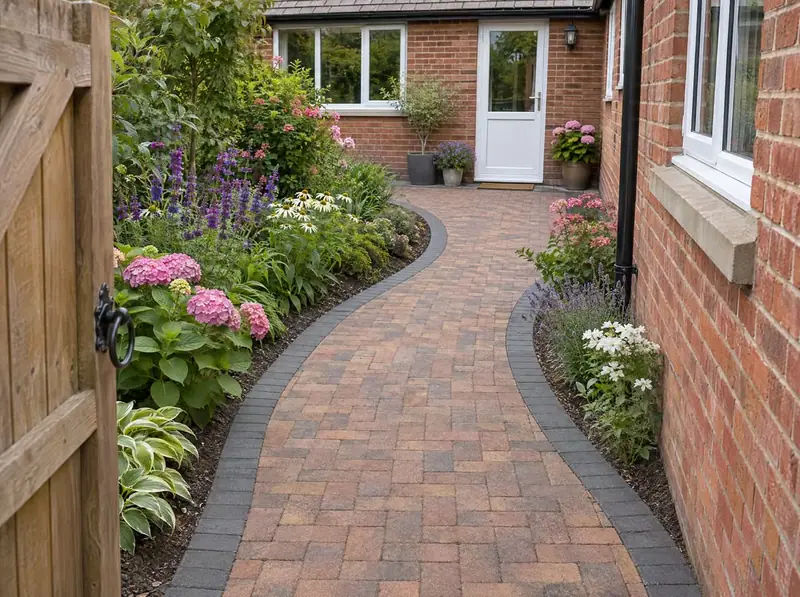
Block paved paths and side passages
Front paths, garden paths and side passages that stay level and drain well.
From £90 per m²Learn more →