What does a block paved driveway involve?
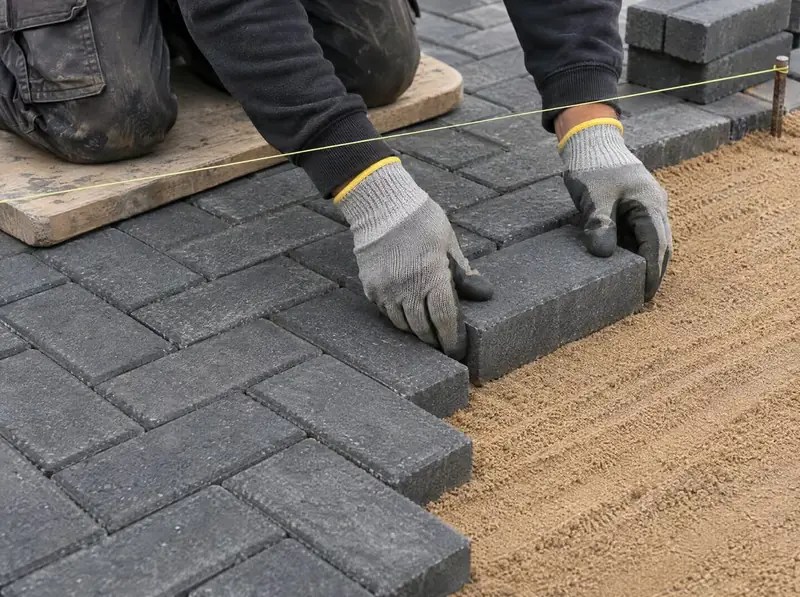
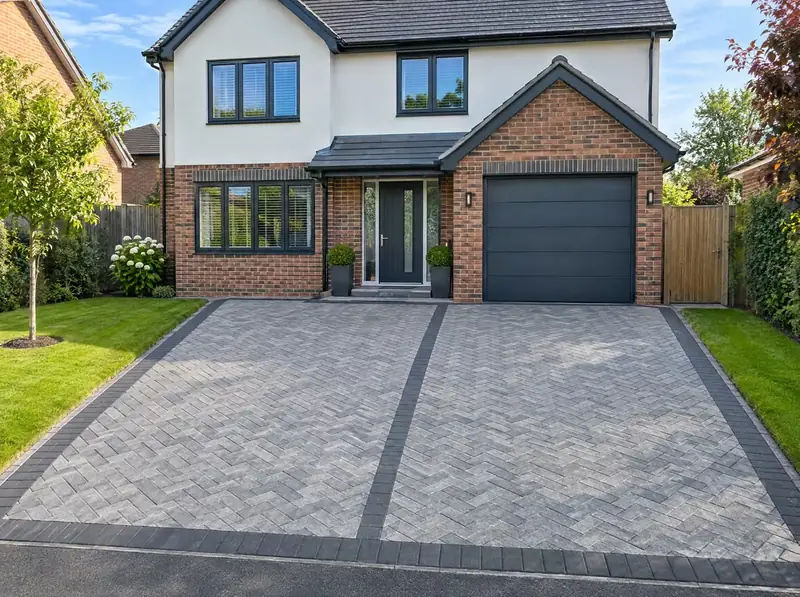
A block paved driveway is a surface of small concrete or clay blocks laid tightly on a bed of sharp sand, held in by a fixed edge and locked together with kiln-dried jointing sand. Laid on a properly dug and compacted sub-base, it carries cars for decades, and a single damaged block can be lifted and replaced without breaking the surface.
We build block drives for homeowners from scratch: digging out the old surface, setting edge restraints in concrete, building and compacting the sub-base, screeding the laying course, laying the pattern, cutting in the edges and vibrating the blocks into the sand. Every quote states the depth of dig, the sub-base thickness, the edging, the falls and where the water goes.
What is included?
- Survey, measurements and a written, itemised quote
- Removal of the old surface and soil to the agreed depth, with waste taken away
- Edge restraints or kerbs bedded and haunched in concrete
- Crushed-stone sub-base laid in layers and compacted
- Sharp-sand laying course screeded to falls
- Blocks laid in your chosen pattern, with a contrasting border if wanted
- Cuts at edges, around covers and against the house
- Kiln-dried sand brushed in and the surface vibrated with a plate compactor
Which options are there?
Concrete block
The most popular choice for drives: consistent size, wide colour range and the best value per square metre. Most drives use 50 mm or 60 mm blocks; 60 mm or 80 mm suits heavier use.
Tumbled and cobble-effect
Concrete blocks with softened edges and mixed sizes for a traditional, aged look. They cost more than standard blocks and take longer to lay.
Clay pavers
Fired clay keeps its colour for decades and suits period homes. Clay costs more and is harder to cut cleanly.
Permeable block
Blocks with wider joints laid on an open-graded stone base so rain drains through the drive instead of off it.
How much does a block paved driveway cost?
For a 50 m² double drive in the Midlands, that typically comes to £4,250–£7,000. London and the South East cost more, the North East, Yorkshire and Wales a little less. Smaller jobs cost more per square metre because set-up and waste costs do not shrink with the area.
| Region | Guide price inc VAT |
|---|---|
| London | £100–£170 per m² |
| South East | £90–£150 per m² |
| East of England | £90–£145 per m² |
| South West | £85–£140 per m² |
| West Midlands | £85–£140 per m² |
| East Midlands | £85–£140 per m² |
| North West | £85–£140 per m² |
| Yorkshire and the Humber | £75–£125 per m² |
| North East | £75–£125 per m² |
| Wales | £80–£130 per m² |
| Scotland | £85–£140 per m² |
| Northern Ireland | £80–£135 per m² |
Guide figures checked 9 November 2026. Your written quote after the survey is the price you pay. See the full price list or try the guide price tool.
Is a block paved driveway right for you?
Good for
- You want a drive that can be repaired block by block
- You park more than one car or a van
- You want a pattern, border or parking bays marked in the paving
Think twice if
- You need the cheapest possible surface (gravel or tarmac cost less)
- The drive is very steep and you want a jointless finish
How does it work?
Send the basics
Postcode, what you need and a rough size. Photos help.
Survey
We measure, check levels, ground and drainage, and talk through blocks and patterns.
Written quote
An itemised quote with the specification, the price and the start date.
The work
Our paving team builds it to the agreed specification and leaves the site swept.
Do you need permission?
Front-garden paving and dropped kerbs follow different rules in each part of the UK:
Front drive rules in England
In England, paving in front of the house that covers more than 5 m² needs planning permission unless it is permeable or drains to a lawn, border or soakaway inside your boundary. Permeable block paving, or standard blocks laid to fall onto a planted strip, avoid the need for permission in most cases.
Flats and maisonettes, listed buildings, and homes covered by an Article 4 direction can have tighter rules, and conservation areas, National Parks and National Landscapes restrict some permitted development.
A dropped kerb needs your local highway authority's approval (usually the county, unitary, metropolitan or London borough council), and a new access onto an A, B or C classified road also needs planning permission.
Front drive rules in Wales
In Wales, any new or replacement hard surface at the front of a house should be permeable or drain to a permeable area within the property to avoid needing planning permission. Unlike England, there is no 5 m² allowance for new paving; only repairs of up to 5 m² of existing surface are exempt.
Since January 2019, construction work covering 100 m² or more with drainage implications, including drives and patios, needs approval from the local SuDS Approving Body (SAB) before work starts, even where planning permission is not needed.
A dropped kerb needs your council's approval as highway authority, and a new access onto a classified road needs planning permission.
Front drive rules in Scotland
In Scotland, a hard surface between the house and the road is permitted development only if it is porous or drains to a permeable area within the property. There is no 5 m² threshold: the rule applies whatever the size.
Hard surfaces are not permitted development in a conservation area or within the grounds of a listed building, so planning permission is needed there.
A dropped kerb needs consent from your council as roads authority under section 56 of the Roads (Scotland) Act 1984, and planning permission may also be needed depending on the road.
Front drive rules in Northern Ireland
In Northern Ireland, a hard surface between the front of the house and the road that covers or replaces more than 5 m² must be porous or permeable, or drain to a permeable area within the property, to be permitted development.
Hard surfaces within the grounds of a listed building need listed building consent. Planning is handled by your district council, so check with its planning office if you are unsure.
Dropped kerbs in Northern Ireland are approved by DfI Roads (the Department for Infrastructure), not the council; check planning separately with the council.
Questions about block paved driveways
How long does a block paved driveway take to lay?
Most single and double drives take three to seven working days, depending on the size, how much has to be dug out, and how many cuts the shape needs. Your quote gives an expected duration.
How deep should the sub-base be for a driveway?
For a domestic drive the MOT Type 1 sub-base is usually at least 150 mm after compaction, more on soft or clay ground, so the dig is typically around 200 to 250 mm. The survey checks the ground and the quote states the depth.
Can you drive on block paving straight away?
Usually yes. There is no curing time for the blocks: once they are vibrated into the sand and the joints are filled, a correctly laid drive can be driven on straight away. Keep wheels off newly concreted kerbs for a few days, and expect to top up the joint sand after a few weeks as it settles.
Which pattern is best for a driveway?
Herringbone (at 45 or 90 degrees) is the usual choice for drives because the interlocking blocks resist turning wheels better than stretcher bond or basketweave.
Do I need planning permission for a block paved drive?
In England, not for the surface itself if it is permeable, drains to a lawn or border within the property, or the front area is 5 m² or less. Wales and Scotland have no 5 m² allowance for new front paving, and Northern Ireland has its own order; see our planning guide or ask on the survey.
Will weeds grow through block paving?
A few seeds can root in the joint sand over time. Full joints, a sealer and an occasional sweep keep it to a minimum; weeds rarely come up from below through a properly built sub-base.
Where do you offer block paved driveways?
We quote block paved driveways across the UK. Choose your area for local prices and towns.
- Bedfordshire
- Berkshire
- Bristol
- Buckinghamshire
- Cambridgeshire
- Cheshire
- Cornwall
- Cumbria
- Derbyshire
- Devon
- Dorset
- County Durham
- East Riding of Yorkshire
- East Sussex
- Essex
- Gloucestershire
- Greater London
- Greater Manchester
- Hampshire
- Herefordshire
- Hertfordshire
- Isle of Wight
- Kent
- Lancashire
- Leicestershire
- Lincolnshire
- Merseyside
- Norfolk
- North Yorkshire
- Northamptonshire
- Northumberland
- Nottinghamshire
- Oxfordshire
- Rutland
- Shropshire
- Somerset
- South Yorkshire
- Staffordshire
- Suffolk
- Surrey
- Tyne and Wear
- Warwickshire
- West Midlands
- West Sussex
- West Yorkshire
- Wiltshire
- Worcestershire
- Clwyd
- Dyfed
- Gwent
- Gwynedd
- Mid Glamorgan
- Powys
- South Glamorgan
- West Glamorgan
- Aberdeen and Aberdeenshire
- Dundee and Angus
- Argyll and Bute
- Ayrshire
- Dumfries and Galloway
- Edinburgh and the Lothians
- Fife
- Forth Valley
- Glasgow and Dunbartonshire
- Highlands
- Lanarkshire
- Moray
- Perth and Kinross
- Renfrewshire and Inverclyde
- Scottish Borders
- County Antrim
- County Armagh
- County Down
- County Fermanagh
- County Londonderry
- County Tyrone
Related services
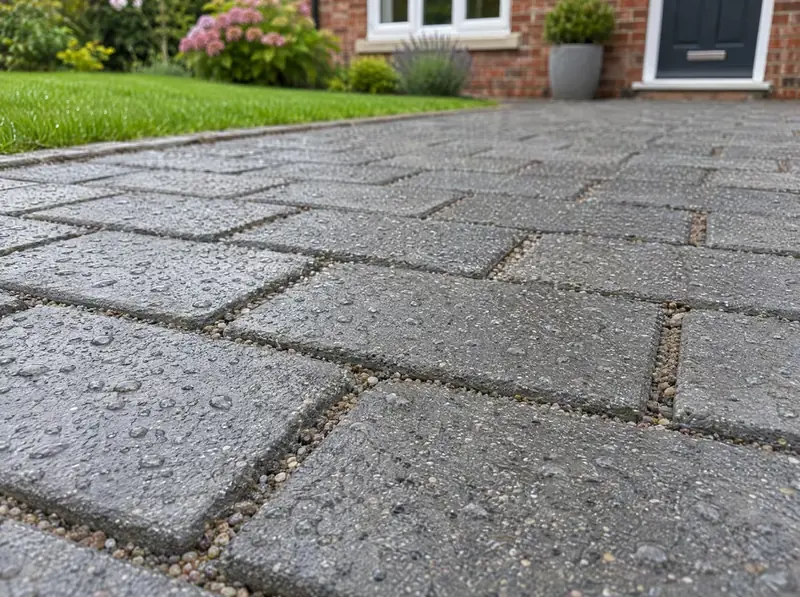
Permeable block paving
A block drive that lets rain soak through, so the surface itself manages the water.
From £105 per m²Learn more →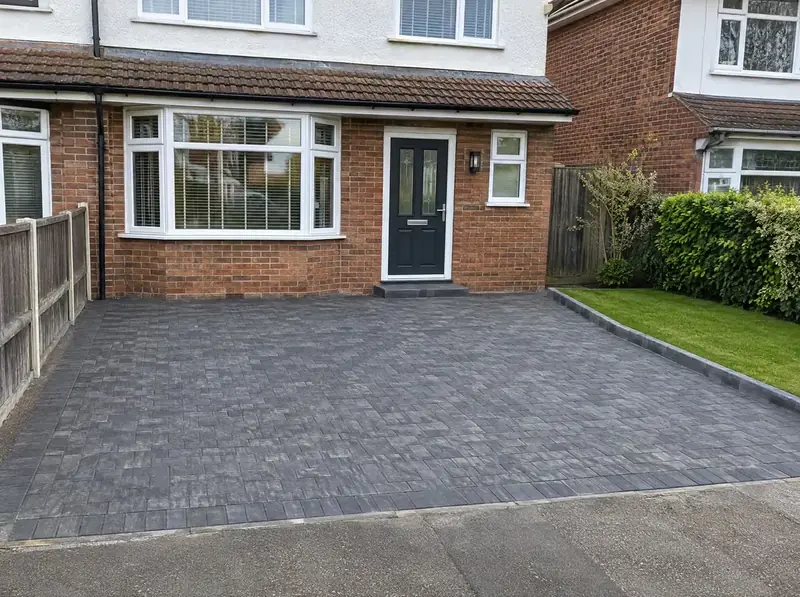
Block paved driveway extensions
Widen or lengthen your drive, matched to the existing paving or with a planned contrast.
From £90 per m²Learn more →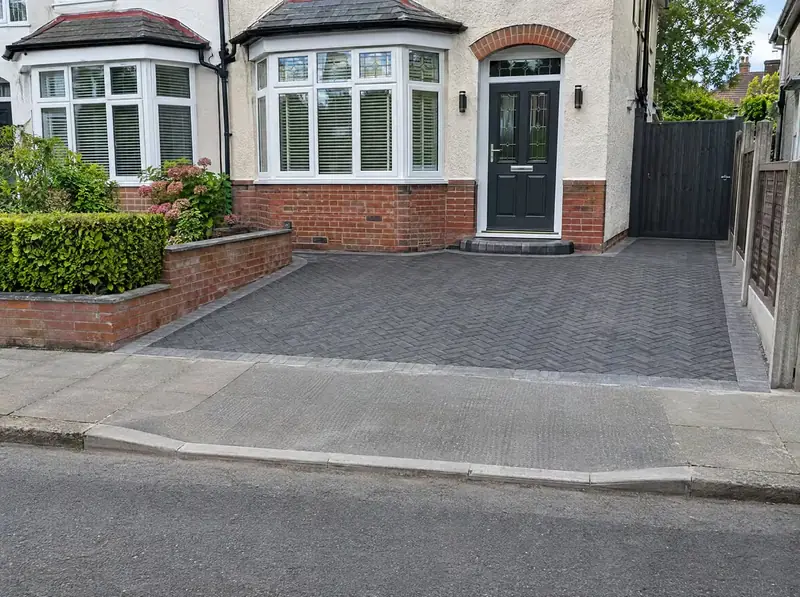
Dropped kerbs with a new drive
A legal vehicle crossing over the pavement, applied for and built to the authority's rules.
From £1,000 Learn more →