How much does a clay paver drive cost in Fife?
Guide price in Fife: £115–£170 per m² including VAT, which puts a 40 m² drive at about £4,600–£6,800. These are Scotland guide figures; the survey confirms the real price before you commit.
| Item | Guide price inc VAT |
|---|---|
| Clay paver driveway | £115–£170 per m² |
| Breaking out an old surface | £10–£40 per m² |
| Edging or kerb, bedded and haunched | £20–£50 per metre |
| Typical channel drain run | £350–£1,000 |
| Dropped kerb (vehicle crossover) construction | £1,000–£3,000 |
Guide figures for Scotland, checked 9 November 2026.
Towns we cover in Fife
We quote clay pavers in every town across Fife, including:
What is included?
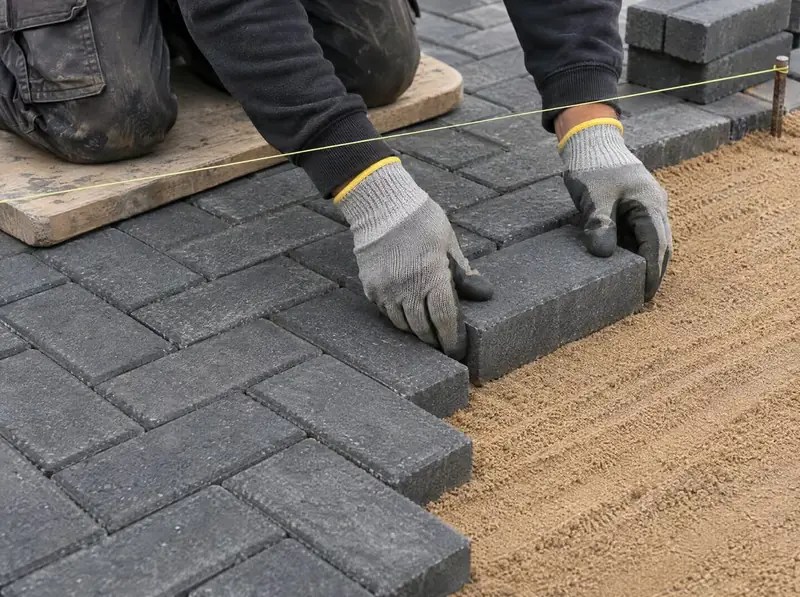
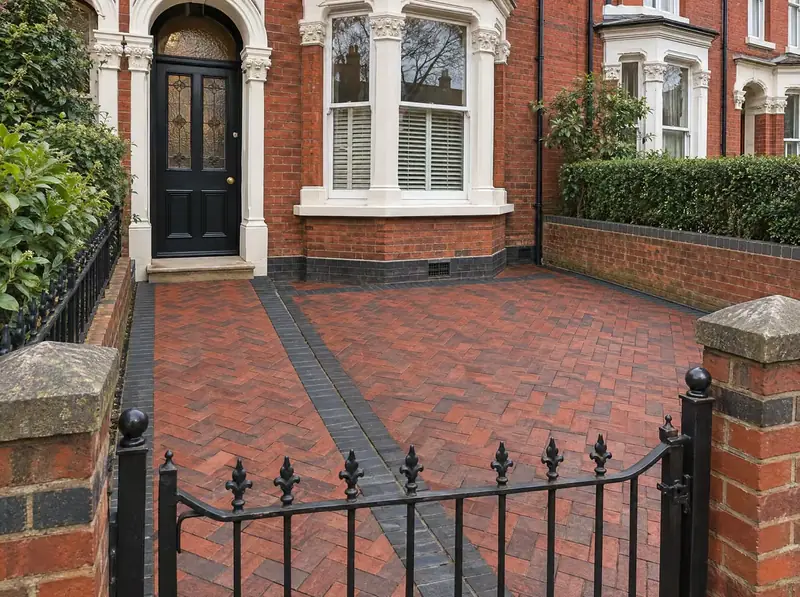
Clay pavers are laid on the same kind of compacted sub-base and sand bed as concrete blocks, but they vary slightly more in size and are harder to cut cleanly, so laying takes longer and the cost per square metre is higher. They are a natural match for Victorian, Edwardian and Arts and Crafts houses.
Frost and heavy rain test paving in Scotland, so a well-drained sub-base and full joints matter as much as the blocks.
- Dig-out, edging and compacted sub-base
- Advice on paver colour and size to suit the house
- Clean cuts with a wet saw where the pattern meets edges and covers
- Jointing sand brushed in and the surface compacted with a protective pad
- Clay pavers laid in herringbone, basketweave or stretcher bond
What the survey covers
- Access for a mini-digger, skip or grab lorry
- Levels against the damp-proof course (the finished paving must sit at least 150 mm below it)
- Ground conditions under the old surface and how deep the sub-base must be
- Where an electric vehicle charger cable might run
- Where rain will go: falls, lawn, border, channel or soakaway
Rules for front drives in Fife
In Scotland, a hard surface between the house and the road is permitted development only if it is porous or drains to a permeable area within the property. There is no 5 m² threshold: the rule applies whatever the size.
Hard surfaces are not permitted development in a conservation area or within the grounds of a listed building, so planning permission is needed there.
A dropped kerb needs consent from your council as roads authority under section 56 of the Roads (Scotland) Act 1984, and planning permission may also be needed depending on the road.
General guidance, not legal advice. Your survey confirms what applies to your home. See the planning guide.
How it works
Quick details
Your postcode and the job. It takes a minute.
On-site check
Measurements, levels against the damp-proof course, ground and drainage.
Itemised quote
Fixed once the specification is agreed, with no vague extras.
Laid and finished
Compacted, jointed and handed back clean.
Clay pavers in Fife: questions
What happens to my old drive?
It is broken out and taken away by skip or grab lorry, listed as its own line on your quote.
How long does a clay paver drive take to build?
Most homes take between three and seven working days, depending on size, the dig and the drainage. Your quote gives the expected duration.
Do you cover Dunfermline, Kirkcaldy and Glenrothes?
Yes. We cover all of Fife, including Dunfermline, Kirkcaldy and Glenrothes.
Do I need planning permission for a clay paver drive in Fife?
In Scotland, front paving must be porous or drain within your boundary at any size, and permitted development does not apply in conservation areas. Ask us on the survey if you are unsure.