How much does a cobble-effect block drive cost in Cumbria?
For Cumbria, our guide is £100–£160 per m² including VAT, so a 50 m² drive is likely to be £5,000–£8,000. Smaller jobs cost more per square metre because set-up and waste costs do not shrink with the area.
| Item | Guide price inc VAT |
|---|---|
| Tumbled or cobble-effect concrete block driveway | £100–£160 per m² |
| Breaking out an old surface | £10–£40 per m² |
| Edging or kerb, bedded and haunched | £20–£50 per metre |
| Typical channel drain run | £350–£1,000 |
| Dropped kerb (vehicle crossover) construction | £1,000–£3,000 |
Guide figures for the North West, checked 9 November 2026.
Towns we cover in Cumbria
We quote cobble-effect paving in every town across Cumbria, including:
What does a cobble-effect block drive involve?
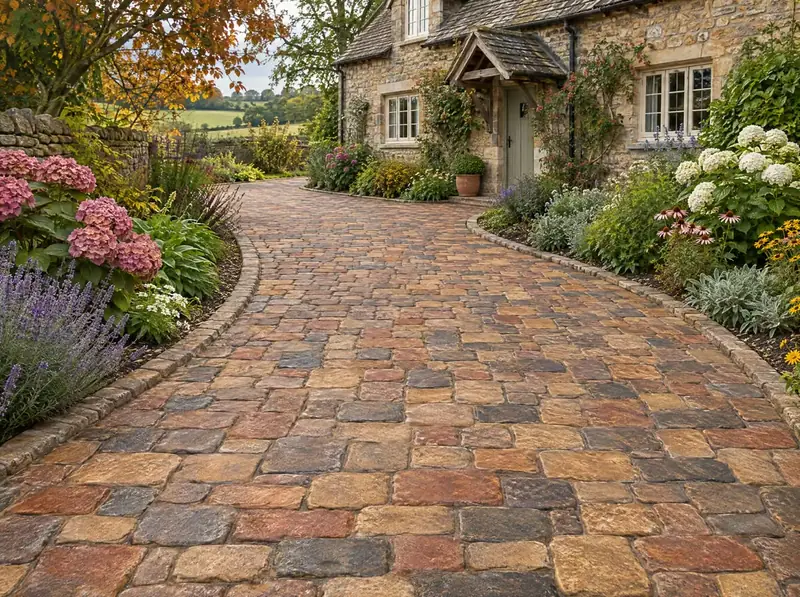
Tumbled block paving is concrete block that has been rumbled or treated after making so the edges are rounded and the faces look worn. Cobble-effect ranges add three or more block sizes laid in a random or coursed pattern, which gives the look of old setts without their cost or rough surface.
The North West is one of the wetter parts of England, so falls, channel drains and permeable options matter more than usual.
- Jointing sand and compaction
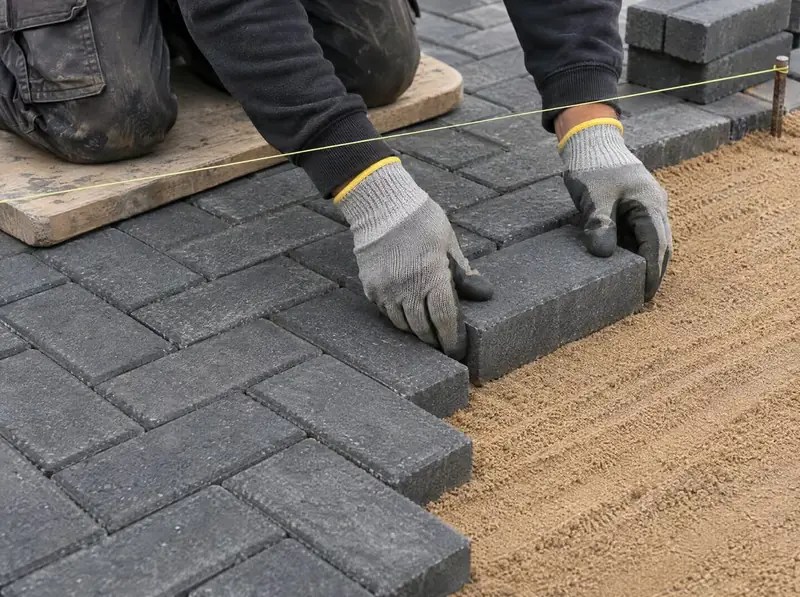
- Dig-out, sub-base and edging as for any block drive
- Colour and size mix chosen on the survey
- Mixed sizes laid to a planned random or coursed pattern
- Edge cuts blended into curves and corners
What the survey covers
- Whether front-garden planning rules apply
- Existing manhole and inspection covers, and whether to recess them
- Steps, thresholds and door heights
- The kerb: is it already dropped, and is it wide enough?
- Access for a mini-digger, skip or grab lorry
Rules for front drives in Cumbria
In England, paving in front of the house that covers more than 5 m² needs planning permission unless it is permeable or drains to a lawn, border or soakaway inside your boundary. Permeable block paving, or standard blocks laid to fall onto a planted strip, avoid the need for permission in most cases.
Flats and maisonettes, listed buildings, and homes covered by an Article 4 direction can have tighter rules, and conservation areas, National Parks and National Landscapes restrict some permitted development.
A dropped kerb needs your local highway authority's approval (usually the county, unitary, metropolitan or London borough council), and a new access onto an A, B or C classified road also needs planning permission.
General guidance, not legal advice. Your survey confirms what applies to your home. See the planning guide.
How it works
Send the basics
Postcode, what you need and a rough size. Photos help.
Survey
We measure, check levels, ground and drainage, and talk through blocks and patterns.
Written quote
An itemised quote with the specification, the price and the start date.
The work
Our paving team builds it to the agreed specification and leaves the site swept.
Cobble-effect paving in Cumbria: questions
How long does a cobble-effect block drive take to build?
Most homes take between three and seven working days, depending on size, the dig and the drainage. Your quote gives the expected duration.
Can you match the blocks to my house in Cumbria?
We bring samples to the survey and suggest blocks and borders that suit the age and brick of the house. Final colour is your choice.
Do I need planning permission for a cobble-effect block drive in Cumbria?
In England, a front drive over 5 m² needs planning permission unless it is permeable or drains to a lawn or border within your boundary. Ask us on the survey if you are unsure.
What happens to my old drive?
It is broken out and taken away by skip or grab lorry, listed as its own line on your quote.