Planning a block paved patio in March
March is a smaller town, and many homes have more garden to work with, which leaves room for borders, steps and planting around the paving.
Clay soils are common in parts of the East of England, so drainage and sub-base depth get extra attention.
How much does a block paved patio cost in March?
For March, our guide is £85–£145 per m² including VAT, so a 20 m² patio is likely to be £1,950–£3,400. Smaller jobs cost more per square metre because set-up and waste costs do not shrink with the area.
| Item | Guide price inc VAT |
|---|---|
| Block paved patio (concrete block) | £85–£145 per m² |
| Breaking out an old surface | £11–£40 per m² |
| Edging or kerb, bedded and haunched | £20–£55 per metre |
| Step with block or brick riser and paved tread | £190–£370 per step |
| Typical channel drain run | £370–£1,050 |
Guide figures for the East of England, checked 9 November 2026. See all prices or use the guide price tool.
What does a block paved patio involve?
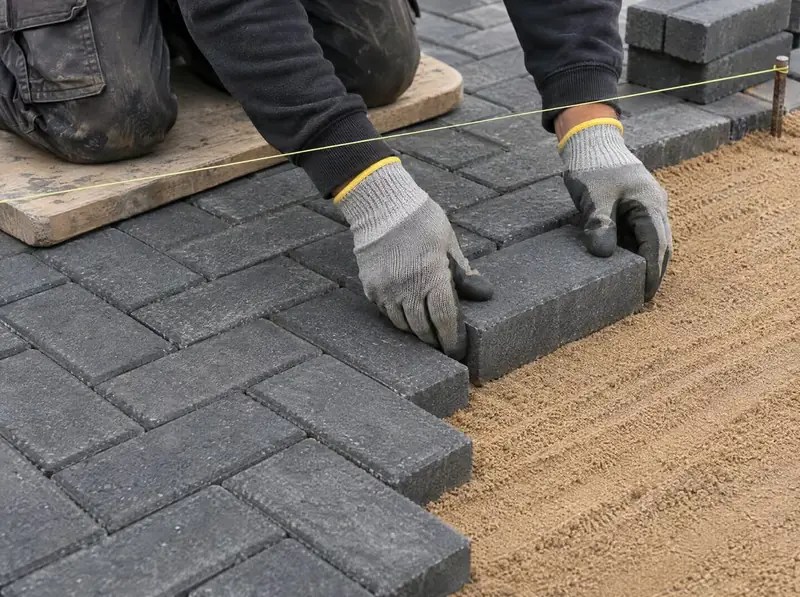
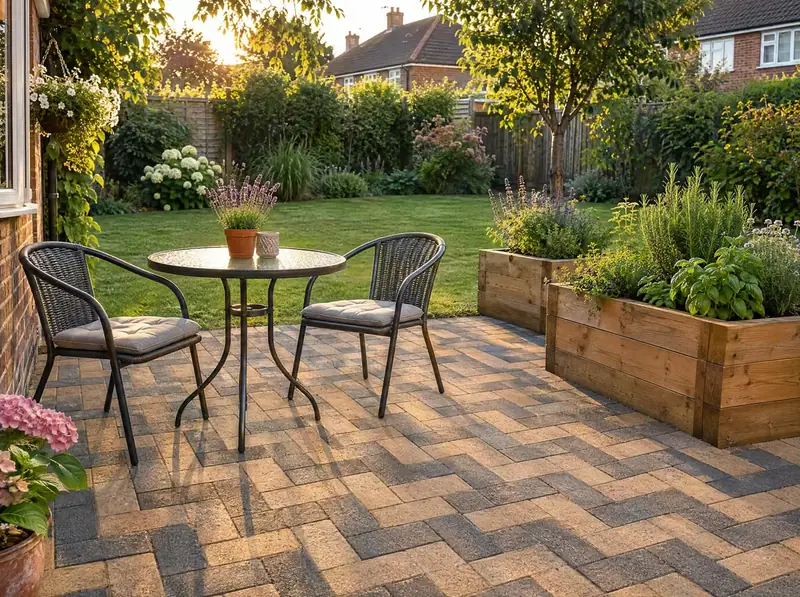
A block paved patio is a garden seating or dining area paved with concrete or clay blocks on a compacted base. Because a patio carries people and furniture rather than cars, the sub-base is thinner than for a drive, but the falls, edging and drainage matter just as much.
- Dig-out and compacted sub-base (around 100 mm for foot traffic)
- Jointing sand and compaction
- Layout marked out with you, including steps and doors
- Falls away from the house and doors
- Optional sealer
What the survey covers
- Levels against the damp-proof course and door thresholds
- Ground conditions and how deep the dig must be
- Trees and roots near the paving
- Edges against lawns, beds, fences and walls
- Steps, walls and changes of level
Do you need permission for a block paved patio in March?
A patio or path behind the house does not usually need planning permission. Raised patios, listed buildings and flats can be different, so we check on the survey.
Paving in front of the house follows the front-garden rules: in England, a front drive over 5 m² needs planning permission unless it is permeable or drains to a lawn or border within your boundary.
From enquiry to finished paving
Send the basics
Postcode, what you need and a rough size. Photos help.
Survey
We measure, check levels, ground and drainage, and talk through blocks and patterns.
Written quote
An itemised quote with the specification, the price and the start date.
The work
Our paving team builds it to the agreed specification and leaves the site swept.
What you can expect from us
Honest timescales
We tell you how long the job takes and what can delay it, such as approvals and weather.
Water planned first
Falls, channels and soakaways are designed before the pattern is chosen.
Itemised quotes
Break-out, waste, edging, drainage and covers are separate lines you can see.
One point of contact
You deal with one team from survey to sign-off, with work carried out by paving teams working under S&K.
Patios in March: questions
How long does a block paved patio take?
Most patios and paths take two to five working days, depending on the size, any steps and the dig. Your quote gives the expected duration.
Is the survey in March free?
Yes, for new paving here: the survey and written quote are free with no obligation. Repairs and cleaning are usually priced from photos, or from a short visit where needed.
Can the paving be level with the back door?
Paving normally sits at least 150 mm below the damp-proof course. A level step-out needs a drainage channel against the house and careful detailing, which we agree on the survey.
Do I need planning permission for a block paved patio in March?
Not usually for a patio or path behind the house. Raised patios, listed buildings and flats can be different, and paving in front of the house follows the front-garden rules. In England, a front drive over 5 m² needs planning permission unless it is permeable or drains to a lawn or border within your boundary.
Patios near March
Nearby towns we cover for patios, and patios across Cambridgeshire: