How much does a block paved path cost in Kent?
Guide price in Kent: £95–£175 per m² including VAT, which puts a 12 m² path at about £1,350–£2,400. These are South East guide figures; the survey confirms the real price before you commit.
| Item | Guide price inc VAT |
|---|---|
| Block paved path or side passage | £95–£175 per m² |
| Breaking out an old surface | £11–£45 per m² |
| Edging or kerb, bedded and haunched | £20–£55 per metre |
| Step with block or brick riser and paved tread | £195–£380 per step |
| Typical channel drain run | £380–£1,100 |
Guide figures for the South East, checked 9 November 2026.
Towns we cover in Kent
We quote paths in every town across Kent, including:
- Maidstone
- Gillingham
- Tunbridge Wells
- Folkestone
- Margate
- Ashford, Kent
- Canterbury
- Sittingbourne
- Gravesend
- Dartford
- Ramsgate
- Dover
- Tonbridge
- Strood
- Whitstable
- Deal
- Sevenoaks
- Rochester
- Herne Bay
- Broadstairs
- Faversham
- Swanley
What is included?
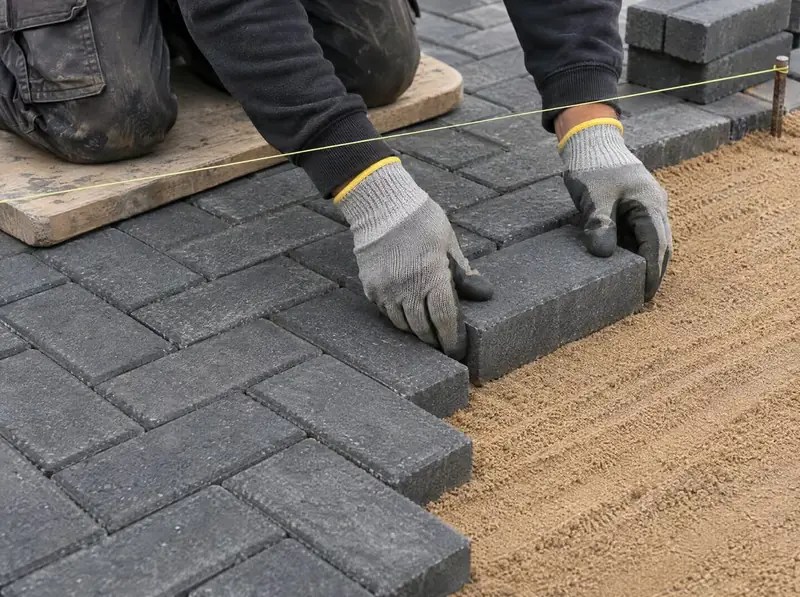
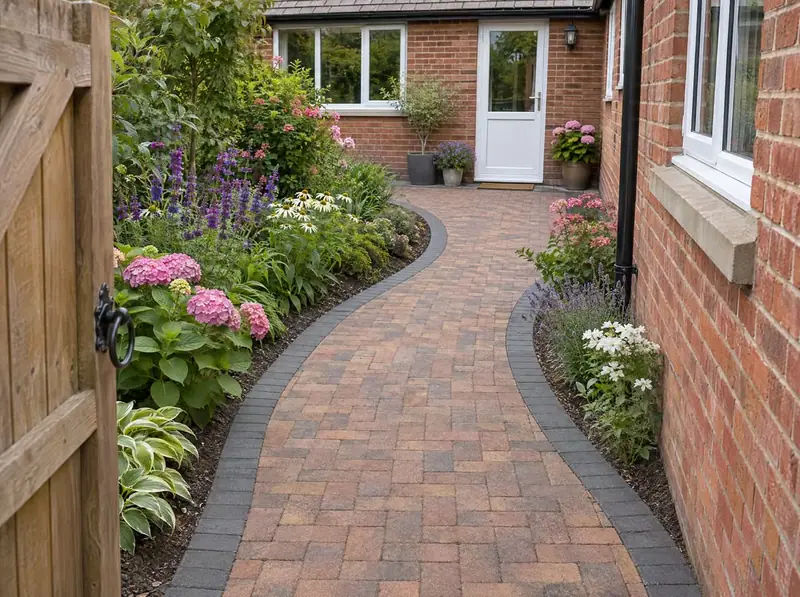
We set edging both sides in concrete, keep steps and changes of level safe and even, and make sure side passages fall away from the house walls and air bricks. Curves are laid with the blocks cut to follow the line rather than leaving ragged edges.
Chalk, clay and sandy ground all occur across the South East, so the dig and sub-base depth are set on the survey rather than assumed.
- Falls away from walls and to gullies
- Blocks, cuts and jointing sand
- Steps formed where levels change
- Dig-out and compacted base
- Edging both sides, bedded and haunched
What the survey covers
- Trees and roots near the paving
- Ground conditions and how deep the dig must be
- Where rain will go: falls away from the house, onto lawn or borders, or into a channel
- Edges against lawns, beds, fences and walls
- Access for a mini-digger and how waste leaves the garden
Do you need permission for a block paved path in Kent?
A patio or path behind the house does not usually need planning permission. Raised patios, listed buildings and flats can be different, so we check on the survey.
Paving in front of the house follows the front-garden rules: in England, a front drive over 5 m² needs planning permission unless it is permeable or drains to a lawn or border within your boundary.
How it works
Quick details
Your postcode and the job. It takes a minute.
On-site check
Measurements, levels against the damp-proof course, ground and drainage.
Itemised quote
Fixed once the specification is agreed, with no vague extras.
Laid and finished
Compacted, jointed and handed back clean.
Paths in Kent: questions
Can the paving be level with the back door?
Paving normally sits at least 150 mm below the damp-proof course. A level step-out needs a drainage channel against the house and careful detailing, which we agree on the survey.
Do I need planning permission for a block paved path in Kent?
Not usually for a patio or path behind the house. Raised patios, listed buildings and flats can be different, and paving in front of the house follows the front-garden rules. In England, a front drive over 5 m² needs planning permission unless it is permeable or drains to a lawn or border within your boundary.
How long does a block paved path take?
Most patios and paths take two to five working days, depending on the size, any steps and the dig. Your quote gives the expected duration.
What happens to my old patio or lawn?
Old slabs, concrete or turf are dug out and taken away, listed as its own line on your quote.